1. What he actually posts
| Video | Length | Client | Headline number | "The one thing" | Framework name |
|---|---|---|---|---|---|
| LJ Hooker Townsville | 2:41 | Real estate office, Queensland | 3.4x appraisals booked, 26x listings converted, in one month | Speed to lead: 5–6 hours → 2 minutes | "The tale of two agencies" (99% vs the top 1%) |
| Peard Real Estate | 3:01 | Real estate group, Perth | 124x lead generation from corporate, overnight | The ad says what the seller wants (a price update), not what the agency likes (a Sold sign) | "Baiting the hook" (worm vs chocolate) |
Both posted 24 May 2026. Both captions end the same way: "Follow for more of the best practises of social media lead generation for Australian real estate sales offices 🤙". Profile bio: "See how I've booked over 6,000+ appraisals for real estate agencies in Aus 👇 commissioncompass.io". That is the whole organic side. Everything else he does is paid ads, see the playbook.
How the frame is built
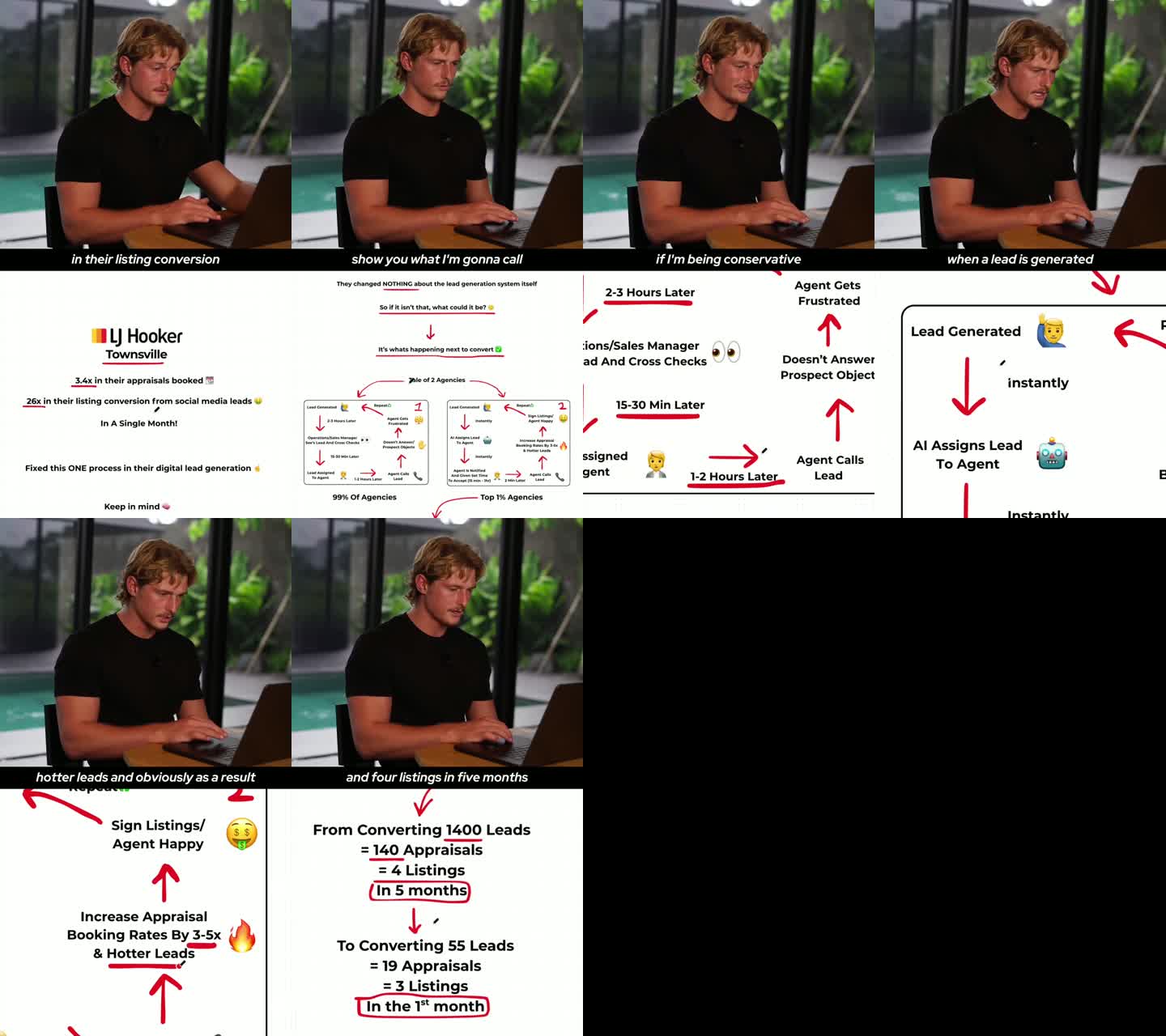
LJ Hooker video, one frame every 25 seconds.
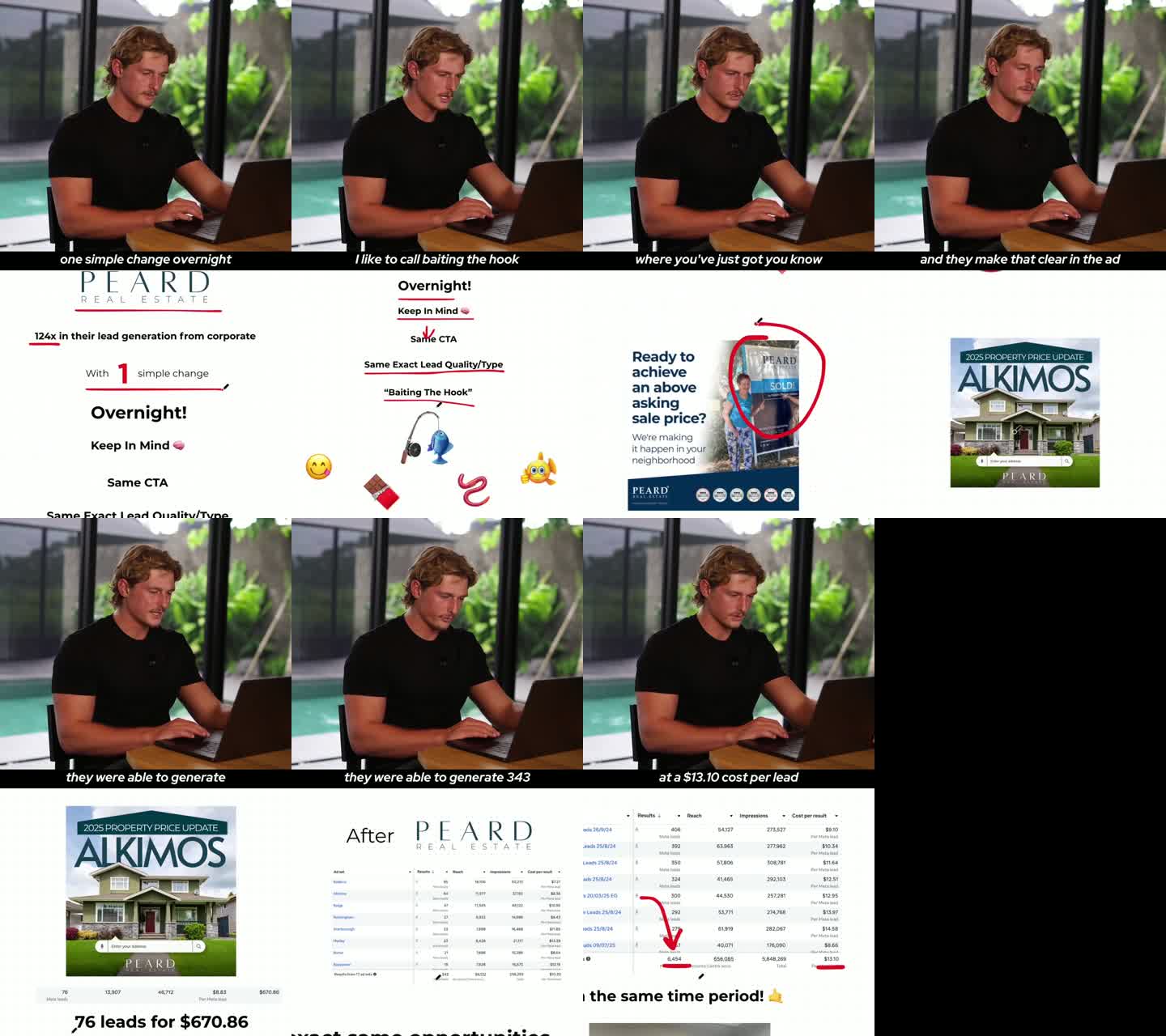
Peard video, one frame every 25 seconds.
- 9:16 split screen. Top half: Dylan at a laptop, side-on, black tee, lav mic, pool and plants behind him, daylight. He looks at the laptop (the board) while he talks, not into the lens.
- Bottom half: a Miro board screen recording. White canvas, big black text, emojis as icons, the client's logo at the top, and red pen underlines, circles and arrows drawn live as he says each number.
- Caption band in the middle, white italic text on black, word-timed.
- One board per video, scrolled top to bottom as the story goes: logo → headline numbers → "Keep in mind 🧠" → framework name with emoji → two-column diagram or two ad screenshots → before/after block → the real Ads Manager screenshot as proof.
- No music, no b-roll, no jump cuts you notice. One take, read off the board. The board does the editing.
2. The skeleton (same 9 beats in both videos)
| # | Beat | LJ Hooker (2:41) | Peard (3:01) |
|---|---|---|---|
| 1 | Call out the avatar by job title, first words | "Real estate agency owners and directors who own one or more offices" | "Real estate agency directors and marketing managers at real estate corporates" |
| 2 | Named client + multiplied result + time box | "LJ Hooker Townsville … 3.4x in their appraisals booked and a 26x in their listing conversion … in a single month" | "Peard Real Estate … 124x in their lead generation from corporate with this one simple change overnight" |
| 3 | "It was ONE thing" + "they changed nothing else" | "they fixed this one process … they changed nothing about the lead generation system itself" | "the exact same call to action and the exact same lead quality and type" |
| 4 | Name the framework (a phrase he can own) | "what I'm going to call the tale of two agencies" | "this concept I like to call baiting the hook" |
| 5 | Side by side on the board: the 99% vs the top 1% | Agency 1: lead → 2–3 h → manager checks → 15–30 min → assigned → 1–2 h → agent calls → no answer → frustrated → repeat. Agency 2: lead → instantly AI assigns + checks CRM → agent notified, 15 min–1 h to accept → 2 min → call → 3–5x bookings → listings → happy → repeat | Ad A: Sold sign, logo and awards take a quarter, "ready to achieve an above asking sale price". Ad B: "2025 property price update, Alkimos", a house, an address box. "That's all the ad is about" |
| 6 | Before → after, same input | 1,400 leads = 140 appraisals = 4 listings in 5 months → 55 leads = 19 appraisals = 3 listings in the first month, one agent, "the exact same leads" | $645 for one lead → 76 leads for $670. 52 inquiries at $300 each → 343 last month at $10.20 |
| 7 | Not a fluke (the long-run number) | — (he lets "same leads" carry it) | "over 6,400 inbound appraisal inquiries at a $13.10 cost per lead in the past year" |
| 8 | Emotional close | "So it was smiles all around" | "So it was smiles all around in corporate" |
| 9 | Soft CTA, no link, no price | "feel free to give me a follow or you can just message me. I'll be happy to chat" | "drop me a follow or just shoot me a message. I'll be happy to have a chat" |
Word count 523 and 558. He speaks at about 185 words a minute. Three minutes is the ceiling, and both stay under it.
3. Full transcripts
LJ Hooker Townsville, 2:41 (Whisper transcription, unedited)
Real estate agency owners and directors who own one or more offices, I want to show you how LJ Hooker Townsville was able to have a 3.4x in their appraisals booked and a 26x in their listing conversion from social media leads in a single month. And it was all because they fixed this one process in their digital lead generation. And I want you to keep in mind, they changed nothing about the lead generation system itself. And so if it isn't that, then what could it be? Well, ultimately, it was what was happening next to be able to convert these leads, which was making the difference. And so to be able to illustrate this point, I want to show you what I'm going to call the tale of two agencies. So we have agency one here, which honestly represents 99% of agencies nowadays. And so let's say they're generating leads through Facebook. They'll have a lead generated and then two to three hours later, the operations or sales manager will see the lead and then cross check it. And then 15 to 30 minutes later, they'll assign that lead to an agent. And then usually one to two hours later, if I'm being conservative, the agent will reach out to the lead. And I want you to keep in mind, this is five to six hours after the lead's already been generated. And obviously, as a result, the prospect's either not going to answer or they're going to object on the phone. The agent's going to get frustrated and then the cycle's going to repeat. And then we have agency two here, which would represent probably the top 1% of agencies in this specific field. When a lead's generated, instantly they have AI assigning that lead to an agent and going and cross checking the CRM for them. And then instantly that agent is notified and given a set time to accept. This will usually be somewhere between 15 minutes to one hour, depending on the size of your team. And then two minutes later, that agent will be calling the lead. This will increase appraisal booking rates by three to five times and you'll be getting hotter leads. And obviously, as a result, the agent's going to be signing more listings and be happy with the process. And then that will repeat. I want to make that clear that we went from five to six hours to two minutes speed to lead. And when LJ Hooker Townsville decided to become one of these top 1% agencies, they went from converting 1,400 leads into 140 appraisals and four listings in five months to then converting 55 leads into 19 appraisals and three listings within the first month with one agent. And these were with the exact same leads. They didn't change anything about their lead generation system. So it was smiles all around. So if you want to see more of the best practices for social media lead generation in real estate, feel free to give me a follow or you can just message me. I'll be happy to chat.
Caption: "Sharing how LJ Hooker Townsville had a 3.4x in appraisals booked and a 26x in listings converted from social media leads in a single month. Follow for more of the best practises of social media lead generation for Australian real estate sales offices 🤙"
Peard Real Estate, 3:01 (Whisper transcription, unedited)
Real estate agency directors and marketing managers at Real Estate Corporates, I want to show you how Peard Real Estate was able to have a 124x in their lead generation from corporate with this one simple change overnight. Now, I want you to keep in mind that they had the exact same call to action and the exact same lead quality and type which they were going for. And so they were looking for inbound appraisal inquiries with sellers and for them to be able to book appointments with those people. And so they had a lead form ad running on Facebook. And the way that they were able to have such a drastic change is with this concept I like to call baiting the hook. And so in this case, let's just say you're going fishing. Are you going to bait the hook with a worm or are you going to bait it with chocolate? Well, obviously you're going to bait it with a worm because that's what the fish actually wants. But too often, I'm finding that real estate corporates, what they'll do is they'll bait the hook with chocolate because that's what they like. And they're going to run ads which they think will be able to convert. And so what happens is that you end up with ads like this, where you've just got a just sold sign, a quarter of the ad is taken up by their logo and the awards that they've won. And they say something general like ready to achieve and above asking sale price. Whereas when the prospect sees this, it does not communicate to them at all that they're going to get an appraisal. Whereas in this case where they've actually baited the hook with the worm, so what the prospect actually wants, it's for a property price update and they make that clear in the ad. And that's all the ad is about. Obviously, you've got branding elements here, but we want to make sure that the prospect knows what they're looking for. And so how this actually ends up playing out is that in this example, they spent $645 to generate one lead. Whereas when they had changed their campaign and they had implemented one of these types of ads, they were able to generate 76 leads for $670. So for basically the exact same budget, they were able to get 76x in their lead generation. And so before, Peard had only generated 52 inbound appraisal inquiries through Facebook at a $300 cost per lead on average. And then after making these changes, they were able to generate 343 inbound appraisal inquiries last month at a $10.20 cost per lead. So they were basically paying 30 times more for the exact same opportunities. And to illustrate that this wasn't just some random fluke that had happened last month, they've been able to generate over 6,400 inbound appraisal inquiries at a $13.10 cost per lead in the past year, basically the same time period which had only generated 52. So it was smiles all around in corporate. So if you want to find out more about the best practices of social media lead generation in real estate, feel free to drop me a follow or just shoot me a message. I'll be happy to have a chat.
Caption: "Sharing how Peard Real Estate were able to have a 124x in their lead generation from corporate OVERNIGHT with 1 simple change! Follow for more of the best practises of social media lead generation for Australian real estate sales offices 🤙"
4. The rules behind it (copy these, not his words)
- One client, one number, one change. Never two lessons in a video. The whole video defends one multiplier.
- The multiplier is from the client's own numbers, and he shows the raw numbers both sides, so the viewer can do the division. 1,400→140→4 vs 55→19→3.
- "They changed nothing else." That line is what makes the one change believable. Say what stayed the same before you say what changed.
- Name the mechanism so it can be repeated by others: "speed to lead", "baiting the hook", "the tale of two agencies".
- Two columns, not a list. The 99% on the left, the top 1% on the right. The viewer places themselves on the left.
- Time boxes on everything. 2–3 hours, 15–30 minutes, 2 minutes, one month, overnight. Time is what makes it feel like a process and not a pitch.
- Proof on screen, not claims. The Ads Manager rows with the cost-per-lead column; the two real ads side by side.
- "Smiles all around." One soft human line before the CTA. No urgency, no price, no link. The caption and bio carry the link.
- Same opening every time: the avatar's job title, then "I want to show you how [client] was able to…". A viewer who sees three of these knows what they are getting.
5. Your seven videos
Five for DFY (buyers), two for Advisors. Every number below is from the client's own interview or recording in the testimonial folder, and the source is named under each script. Where a story is a community member's and not a DFY delivery, the script says "one of our members" and the truth table says so. Read off the board, 2:30 to 3:00 each.
V1 · DFY · Brandon: $6.5M company, 5% down Accelerator client closed March 2025
Who it calls out: people with a steady job and under $500k cash who think multi-million-dollar businesses are for someone else.
The one thing: he structured the down payment before he went to banks: seller holds 5% so he puts 5% down, and he called banks until the seventh said yes.
Framework name: "The tale of two buyers".
Source: weekly client Q&A recordings 8 Oct 2024, 4 Mar 2025, 1 Apr 2025 (clips in ~/Documents/OnYaRoof-research/advisor-wins/). Facts: $6.5M from $9.8M asking, $3M seller note 8 years 4%, seller holds 5% so 5% down, seventh bank, "could not have done this without the acquisitions team". Use the cropped clips; other participants are visible in the uncropped ones.
V2 · DFY · Marc: a 30-year construction company for under 2x cash flow, no bank member for ~2 years LOI accepted, closing Nov
Who it calls out: people with capital who are tired of projects that take years to pay.
The one thing: he gave the broker a deadline and meant it.
Framework name: "The Friday rule".
Source: Drive "3 - Marc" (full interview youtu.be/plwvM7PZIE8). Facts as he said them: $5M revenue, ~$530k cash flow, $875k price (plus ~$200k working capital so "really 1.1"), 4–5 months, deadline Friday, $600k down / ~$400k seller note, closing November, estimator doubles revenue. Marc is also the one advisor-side video on file (JllQ18korVc): check which hat he wears before you call him a DFY client in the caption.
V3 · DFY · Mohan: employed podiatrist to practice owner, 5% down course member owner 8+ months
Who it calls out: doctors, dentists, anyone with a licence who works inside someone else's practice.
The one thing: he stopped shopping sectors and bought what he already knew.
Framework name: "The staring-at-you deal".
Source: Drive "15 - Mohan" (youtu.be/DCDamutwaD8). His result is a broker deal he ran himself; he credits the course with the mindset ("Acquisitions University … got me in the mindset"). Say "one of our members", not "our client's deal".
V4 · DFY · Robert & Shamila: no money, three businesses on one address community interview
Who it calls out: people who are sure they have no money for this.
The one thing: they valued the location and its income streams, not the seller's ugly books.
Framework name: "Count the streams, not the spreadsheet".
Source: Drive "26 - Robert" (youtu.be/hJvIK01w-K8). A community interview: their deal was not a DFY delivery. Say "members of our community".
V5 · DFY · Tyler: ten acquisitions, and where the deals really were community interview came to us to go bigger
Who it calls out: people who have been scrolling marketplaces for a year and never bought anything.
The one thing: his deal flow came from the supplier's counter, not the listing sites. Ours comes from 16 marketplaces, thousands of brokers and owners direct, every day.
Framework name: "Where the deals actually are" (this is your "baiting the hook").
Source: Drive "1 - Tyler" (youtu.be/mfAflgI7_-E). Ten acquisitions, $80–90k to ~$1M revenue each, first one paid back in month one, supplier-counter sourcing, never raised money, more than half seller-financed. Do not say "millions". His deals predate us; he joined to go bigger.
V6 · Advisors · The tale of two advisors no name, verbatim from a paying advisor's call needs consent to name him
Who it calls out: business brokers, CPAs, wealth advisors and real-estate agents who get buyer enquiries and turn them away.
The one thing: advisor two keeps the buyer and plugs them into a system instead of turning them away.
Framework name: "The tale of two advisors".
Source: the three quotes are a paying advisor's words from his pre-purchase calls (reports/client-pain-points-verbatim-2026-10-27.md, "PAID (broker)"). Private calls: quote the words, not the name, until he agrees. The system claims are the platform's own (16 marketplaces, same-day NDAs, analysis and DD reports, POF letter, bank and investor intros) and match the "Process" block in the Drive write-ups. Do not state advisor package prices or "exclusive territory" on video: the signed agreement says no exclusive territory is granted.
V7 · Advisors · Brandon's deal, told from the advisor's chair wording needs Moran's OK
Who it calls out: advisors who sell listings and think a first-time buyer with 5% is a waste of time.
The one thing: the deal was structured before the banks were called, which is work an advisor can do for every buyer.
Framework name: "Structure before the bank".
Source: same as V1. Brandon is a buyer-side client, not an advisor's client. The plan file (19 Oct) already flags that advisor videos retelling buyer wins need Moran's OK on wording; this script says "the work we put behind every advisor's buyers", not "an advisor closed this".
6. The Miro board, exactly
One Miro board, one frame per video, each frame a tall column the width of a phone (the editor crops the bottom half of a 9:16 frame to it). Build the whole frame before you press record; the only thing that happens live is the red pen.
| Block (top → bottom) | What goes in it | Dylan's version |
|---|---|---|
| 1 · Logo / name | Client's first name and the business type. No logo of a company we don't have permission to show. | LJ Hooker Townsville logo |
| 2 · Three headline lines | Each one a number, big, with room under it for a red underline. | "3.4x in their appraisals booked", "26x…", "In a single month!" |
| 3 · "Keep in mind 🧠" | The thing that stayed the same, or the handicap. One line. | "They changed NOTHING about the lead generation system itself" |
| 4 · Framework name | Title case, with two or three emojis that act as icons. | "Baiting the hook" 🎣🍫🪱 |
| 5 · Two columns | Left "most people", right "the top 1%". Boxes joined by arrows, each box one phrase, time boxes in bold, the loop closed with 🔁. The right column ends in ✅ or 🤑. | "Tale of 2 Agencies", 99% vs top 1% |
| 6 · Before → after | Two stacked blocks with the same input written both times so the viewer sees "same leads / same buyer / same money". | "From converting 1400 leads = 140 appraisals = 4 listings in 5 months → 55 leads = 19 appraisals = 3 listings in the 1st month" |
| 7 · Proof screenshot | Something real: the closing-call tile, an LOI with figures blurred, the platform's deal list, an Ads Manager table. Circle the number in red. | Ads Manager rows, "$13.10" circled |
Style: white canvas, black text, one font (Miro's default is fine), text size so that one line fills about 70% of the column width, emojis instead of icons, and red for every annotation. Pen tool, red, medium. Underline numbers as you say them, draw the arrow between the two blocks as you say "went from… to…", circle the time box last.
Red lines to never cross on a board: no client's full name without consent, no bank or lender name, no package price, no "exclusive territory", no figure rounded up from the interview.
7. Recording SOP
| Step | Do this | Why |
|---|---|---|
| 1 · Board first | Build the Miro frame from section 6. Read the script against it once. Change the board, not the script, when they disagree. | He reads the board, which is why it never sounds memorised. |
| 2 · Set | Sit side-on to a laptop at a table, daylight from the front, plain dark top, lav mic clipped. Camera on a tripod at eye level, framed chest-up, in portrait if the phone allows it. Keep the same chair and spot for all seven. | The series looks like one series. |
| 3 · Capture | Record two things at once: the camera (phone, 4K) and the Miro screen (QuickTime or OBS screen recording, with the pen tool active). Clap once at the start to sync. | The editor stacks them: camera top half, Miro bottom half. |
| 4 · Take | One take per video, 2:30–3:00. If you stumble, pause two seconds and restart the sentence; the editor cuts the pause. Annotate in red as you say each number. | Three minutes is the reel ceiling; both of his sit under it. |
| 5 · Edit | 9:16, 1080×1920. Camera top, Miro bottom, a black band in the middle with word-timed white italic captions. No music. Export at 30 fps. | Matches his frame exactly. |
| 6 · Caption | "Sharing how [first name] was able to [result] with one change. Follow for more of what works for first-time business buyers in the US 🤙" (Advisors: "…for advisors who get buyer enquiries"). | Same two sentences every time. |
| 7 · Post | Instagram Reel + Facebook page + YouTube Shorts (under 3:00) on the same day. One a week for seven weeks, Tuesday morning US Eastern. | Cadence is what builds the retargeting pool his coach talks about. |
| 8 · Reuse | Cut each one to a 45–75 second ad: beats 1, 2, 6, 9 only. Run it as a cold ad to the DFY and Advisors landing pages with the four-line copy formula from the playbook. | His talking-head ads are 0:44–1:55; this is where the organic video becomes the ad. |
8. Who said what, and whose result it is
| Video | Person | Relationship | Result attributable to us? | Consent to name | Source |
|---|---|---|---|---|---|
| V1, V7 | Brandon Muniz | Accelerator client (buyer) | Yes. "Could not have done this without the acquisitions team." | Said on a recorded client call; confirm before a public video | advisor-wins/README.txt + 4 clips |
| V2 | Marc | Member ~2 years; also the one advisor-side testimonial on file | Partly. "This stuff works and I'm grateful I'm in this group." | Interview was recorded for publishing; confirm | Drive "3 - Marc" |
| V3 | Mohan | Course member | Mindset only; he ran the broker deal himself | Interview was recorded for publishing; confirm | Drive "15 - Mohan" |
| V4 | Robert & Shamila | Community interview | No. Their own deal. | Confirm | Drive "26 - Robert" |
| V5 | Tyler | Interview; joined to go bigger | No. His ten deals predate us. | Confirm | Drive "1 - Tyler" |
| V6 | A paying advisor (broker) | Advisor client, $6k | The quotes are his, before joining | Private sales calls: no name without his yes | reports/client-pain-points-verbatim-2026-10-27.md |
Dylan's two videos are both about his own clients' results from his own service, which is what makes them case studies. V1, V6 and V7 are the same kind. V2–V5 are member stories: they teach the mechanism and the process, and the script says "one of our members" so they never claim a result we did not deliver.